Posts Tagged Private Equity

Archive entries filed under Private Equity.

Showing 69 results.Tag: Private EquityClear filters

Seventy-Eight

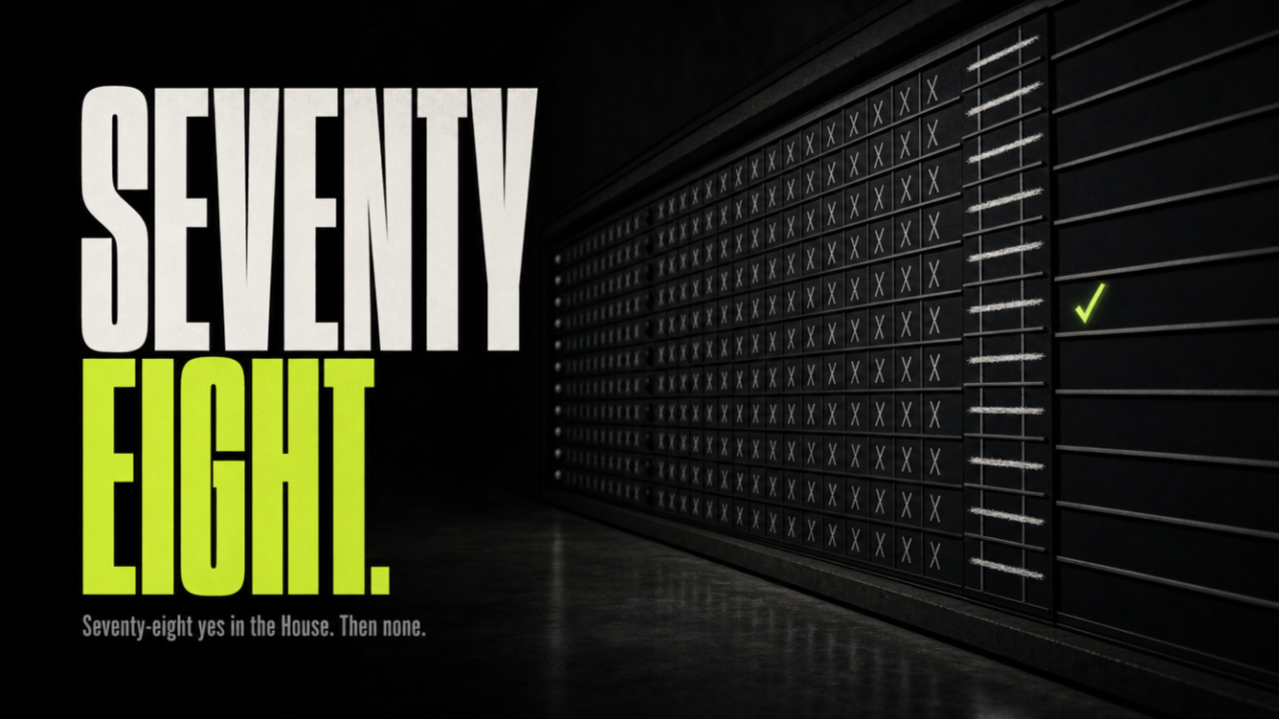
On the afternoon of 15 September the Senate declined to begin debating the CLARITY Act. The result was on the wire within minutes of the vote, and the result is the least interesting thing in the record. What is interesting sits in the roll call, and the roll call only means something next to a second one taken the same afternoon and a third taken fourteen months earlier. The vote was cloture on the motion to proceed, which decides whether the Senate may begin debating a bill. It is not passage and it enacts nothing. A bill that fails it has not been voted down on its merits. It has failed to reach the point at which its merits get debated. The threshold is three-fifths of senators sworn, which is sixty. The 7 September piece argued that the question of whether Kalshi's sports contracts are federally regulated derivatives or unlicensed gambling had three live routes to an answer, judicial, legislative and administrative. This is what the legislative test produced, and it produced more than a number.

Wall Street Just Conceded the Argument

For years the standard defense of private markets ran like this: illiquidity is a feature rather than a bug, lock-ups force discipline, and the absence of a daily price is what lets managers think long-term. If an investor cannot sell for ten years, that is the price of admission to the best returns in finance. It was always a convenient story, and the people telling it were the ones who benefited from investors being unable to leave. This year the people who built that system started dismantling it. Morgan Stanley, with roughly $8 trillion under management, is building blockchain settlement infrastructure in-house rather than renting it. At an industry summit in March, its head of digital asset strategy said the firm needs to build this internally because it cannot simply rent the technology. The bank is preparing an institutional digital wallet for tokenized assets, support for tokenized equities on its own trading venue and, most tellingly, it is advancing tokenized private equity secondary markets. That last item deserves a second reading. A bulge-bracket bank is building secondary markets for private equity. The entire point of a secondary market is to let people sell something before it matures. That is liquidity, the thing private markets spent a generation insisting investors did not need. Morgan Stanley is not alone, and none of this is new in principle. Hamilton Lane and KKR have offered tokenized feeder funds through Securitize for several years, cutting minimums on institutional-only funds from millions to tens of thousands. What changed in 2026 is that the work stopped being a fintech experiment at the edge and became core infrastructure strategy at the center of Wall Street. When the incumbents start building the exit that investors were told they did not need, the original argument is finished.

Tokenization Was the Easy Part. Pricing It Is the Hard Part.

Putting an asset on-chain is no longer the hard problem. Anyone can mint a token. The harder problem, and the one the rest of the industry is now racing to solve, is telling the chain what that token is actually worth. The distinction gets lost in most tokenization coverage, and it is worth being precise about, because it is also the problem Tessera is working on. There are two separate data problems for any tokenized real-world asset, and they are not the same problem. The first is proving the asset exists. Does the token have something real behind it, and are the reserves backing it actually there? This is what Chainlink Proof of Reserve does. Tessera's Proof of Reserve feed is live on Solana mainnet, verifying on-chain that the reserves backing T-Tokens exist. That is the integrity layer, and it answers the question of whether the thing is real. The second problem is pricing the asset. What is it worth right now? What net asset value does a lending protocol use to compute a loan-to-value ratio? What number does a perpetual futures exchange reference to mark a position? This is a net asset value and price-feed problem, and it is a fundamentally different piece of infrastructure from Proof of Reserve. Proof of Reserve tells you the backing is there. It says nothing about what the asset is worth. Those are two different oracles answering two different questions, and conflating them is one of the most common mistakes in this space. For most of tokenization's history the industry has concentrated on the first problem, meaning issuance and backing. The last few weeks have made it clear that the frontier has moved to the second. In May, DTCC, the backbone of US securities settlement, said it would use Chainlink for a tokenized collateral platform that automates pricing, valuation and settlement, building on an earlier net asset value pilot run with JPMorgan and BNY Mellon. That is the plumbing of traditional finance treating on-chain valuation as a problem worth solving at scale. It is already in production elsewhere. VanEck and Securitize's tokenized Treasury fund became one of the first assets to qualify as collateral on a major decentralized finance lending market, using a verified net asset value feed to price it. A tokenized asset cannot be used as collateral until a protocol can trust what it is worth. The feed is the precondition: no feed, no collateral. That is the whole story in one line. The valuation layer is what turns a token from something a holder can keep into something a holder can use.

The Rules Were Written for a Different World. This Week Proved It.

Two things happened in capital markets this week that look like routine news taken separately. Taken together they are the same story told from opposite ends. On 14 April, Deutsche Börse, operator of the Frankfurt Stock Exchange and one of the oldest and most systemically important financial market infrastructures in the world, invested $200 million in the crypto exchange Kraken. The stated purpose was to build shared infrastructure spanning trading, custody, settlement, collateral management and tokenized assets. Not a hedge, and not an experiment. A strategic commitment to operating across both worlds at once. On the same day, the US Senate moved materially closer to passing the CLARITY Act, the most significant piece of crypto market structure legislation so far, after a compromise on the stablecoin yield provisions that had blocked it for nearly a year. A Banking Committee markup is expected in the final weeks of April and a Senate floor vote in May. Senator Lummis, the bill's most prominent champion, has described this as the last realistic window before at least 2030. One institution is building the infrastructure without waiting for the rules. The other is finalizing rules for infrastructure that is already being built. That is not a contradiction. It is what a structural shift looks like from the inside. Understanding why this week matters requires going back further than 2026. The regulatory architecture of capital markets, meaning mandatory disclosure, accredited investor restrictions, anti-money-laundering obligations and the public and private market distinction, was not designed in the abstract. It was designed for a world in which every financial transaction required intermediaries, and in which those intermediaries introduced counterparty credit risk at every step. Before electronic clearing, share transactions moved through physical certificates, multiple brokers, clearinghouses and correspondent banks. Each link was a point of counterparty exposure, and the longer the settlement chain the greater the systemic risk. Public market regulation, meaning listing standards, audited accounts and mandatory disclosure, developed specifically to manage the risks created when thousands of anonymous investors transact through intermediaries they cannot individually assess. The private market carve-out follows directly from that problem. The accredited investor framework says that if access is restricted to those sophisticated and well capitalized enough to absorb losses and conduct their own diligence, the disclosure burden can be relaxed. The access restriction is itself the risk management tool. It exists not because ordinary investors deserve returns less, but because the settlement infrastructure assumed they needed protection from intermediaries they could not evaluate. Know-your-customer and anti-money-laundering rules followed the same logic. The global framework placed compliance obligations on financial intermediaries, meaning banks, brokers and exchanges, because those were the natural chokepoints in the flow of capital. Regulating every transacting party is impractical. Regulating the infrastructure they transact through is not. All of that was rational, and all of it was designed for a world of intermediated, paper-based settlement with significant information gaps between counterparties. That is not the world now being built in.

SpaceX Showed Us the Numbers. What They Mean.

On 21 April, SpaceX ended seven years of financial silence. For the first time the company disclosed actual numbers publicly. The Analyst Day sessions at Starbase, together with the simultaneous release of the IPO prospectus, gave investors a first look at the financial shape of the business. The headline is Starlink. The combined launch and Starlink businesses generated $15 billion to $16 billion in revenue in 2025, with profits of approximately $8 billion. Starlink alone ended 2025 with roughly 9.2 million subscribers and over $10 billion in revenue. That is a business with disclosed unit economics rather than a projection, and it is the first time those figures have been public. Analysts project Starlink revenue reaching $24 billion by the end of 2026, which is a projection rather than a disclosure. Starlink passed 10 million active subscribers globally in early 2026, adding customers faster than any telecom network has. SpaceX acquired xAI in February 2026 in an all-stock transaction valuing the combined entity at $1.25 trillion, with xAI at approximately $250 billion and SpaceX at $1 trillion at the time. The xAI numbers remain the opaque part. Grok's monetization, compute costs and the capital committed to AI infrastructure have not been fully broken out, and that is what the full S-1 still needs to provide. The governance structure is now confirmed. Musk holds approximately 42% of SpaceX's equity and controls roughly 79% of the votes through super-voting shares. Public investors will hold standard voting shares. This is a founder-controlled company at the ballot box regardless of how many shares trade on Nasdaq.

Analyst Day Is Tomorrow. What Has Changed Since Last Week.

Six days ago these pages argued that SpaceX's Analyst Day on 21 April was the most consequential scheduled event of the month for anyone trying to understand where this listing is headed. It happens tomorrow, and several things have changed since. When the 14 April piece was written, the working target was $1.75 trillion. That figure has since been revised upward, and SpaceX is reported to be testing a valuation above $2 trillion in conversations with prospective investors. At that level the company would list at a valuation no company has carried from its first day of trading. The questions Analyst Day needs to answer have become correspondingly harder. At $2 trillion, SpaceX would trade at roughly 125 times 2025 revenue. What management says tomorrow about Starlink's subscriber economics, the xAI merger's contribution and Starship's commercial timeline has to support a number with no public market comparable. Reported valuation targets in advance of a filing are expectations rather than prices, and they move.

When a Prediction Market Signs a Deal With Fox News, It Is No Longer a Prediction Market

On 7 April, Kalshi and Fox Corporation announced a partnership to integrate Kalshi's real-time forecasts across Fox News Channel, Fox Business Network, Fox Weather and the Fox One streaming platform. Fox News reaches over 200 million people each month. That figure is worth sitting with. Kalshi, a company that did not exist eight years ago and that spent years fighting regulators in court to establish the legal legitimacy of its product, is now embedded in the largest cable news operation in the United States. This is less a marketing deal than a classification event. The conventional framing of prediction markets is that they are places where people bet on outcomes. That framing is increasingly obsolete. What prediction markets produce is more precise: a continuously updated, crowd-sourced probability signal backed by capital. Participants do not vote. They commit money to positions, which means the signal carries accountability that polling and expert commentary do not. The Federal Reserve has called Kalshi data "valuable to researchers and policymakers." Politicians reference their Kalshi odds at rallies. Newsrooms use the data to contextualize breaking events. Roughly 70% of Kalshi's users visit the platform to check forecasts rather than to trade. A prediction market at scale operates as a real-time probability layer for how markets, institutions and the public process uncertainty. The Fox deal is the moment that layer went mainstream.

The Same Playbook. A Different Unicorn.

Monday's piece examined SpaceX and the structural asymmetry that determines who can act when a private company goes public. The argument was not about SpaceX specifically. It was about how private markets are designed, and why the holders who appear best positioned at a listing are often the ones most constrained by it. That argument applies equally to Kalshi. SpaceX builds rockets and satellite internet. Kalshi builds infrastructure for prediction markets. The businesses are entirely different. From a capital markets perspective they share an architecture: late-stage private companies with institutional validation, closed cap tables, and a listing trajectory that is increasingly visible without being accessible. Kalshi raised $1 billion at a $22 billion valuation earlier this year. The round was institutional and the cap table is closed. Whenever Kalshi lists, private equity holders will face the same 180-day lock-up that governs every major IPO, the same window will open, and the same constraints will determine who can act in it. The pattern repeats regardless of sector.

SpaceX Filed. The Window Is Closing.

On 1 April, SpaceX confidentially filed its S-1 with the SEC. A June Nasdaq listing, a targeted $1.75 trillion valuation and up to $75 billion to raise, which would be more than two and a half times the largest US IPO on record. Those figures are reported rather than confirmed, and a confidential filing is an option to list rather than a listing. What the filing settles is less whether than when, and the question worth asking alongside it is who is structurally positioned when it happens. An IPO is not the beginning of the story. It is often closer to the end. When SpaceX goes public, three groups will hold exposure to the event. The first group, private equity holders, have been in for years. They have the lowest cost basis and the largest unrealized gain on paper, and they are subject to a 180-day lock-up from the date of listing. They cannot sell into the public market during the period of peak post-listing enthusiasm. By the time they can, the initial enthusiasm has typically faded and insider supply is weighing on the price. Their gain is real. The window they are excluded from is often the most active one. The second group, buyers on the day, get access at the listing price. That sounds attractive until oversubscription is considered. Circle's listing in June 2025 was twenty-five times oversubscribed, and Robinhood allocated retail investors roughly 11% of what they requested. Effective position sizes are small, and the outcome is timing-dependent in both directions: sell early and the position was a short-term trade, hold long and post-lock-up selling pressure from the first group erodes the gain. The third group are T-SpaceX holders. T-SpaceX is structured as a loan participation right trading on a decentralized exchange on Solana. Because it is not an equity instrument, its holders are not subject to the 180-day lock-up governing the underlying shares. Circle's trajectory illustrates what that asymmetry meant in one case. The stock listed at $31, rose to nearly $299 within three weeks, and had round-tripped almost entirely to its opening price by the time the lock-up expired six months later. The most active window was narrow, roughly three to six weeks, and it was structurally inaccessible to private equity holders. Buyers on the day who caught it held small positions. T-SpaceX holders face neither constraint. They entered at a pre-IPO price, they hold a token that trades continuously, and they face no lock-up. That combination, pre-IPO entry pricing with unconstrained post-listing liquidity, has not historically been available to any single investor class. Two limits belong on that. Continuous tradability describes what the instrument permits rather than what any market will offer, and a token that can be sold still requires somebody willing to buy it. And T-Tokens are not available in the US or other restricted territories.

Who Actually Captures Value When a Unicorn Goes Public?

When SpaceX files for its IPO, three groups of people will hold exposure to one of the most anticipated liquidity events in a generation. Only one of them is structurally positioned to act at the moment of peak liquidity. The other two are constrained, and in one case the constraint is contractual and absolute. Circle's recent listing serves as a live case study. Circle went public on 5 June 2025 at $31 per share. The deal was twenty-five times oversubscribed, and retail investors on Robinhood received roughly 11% of what they requested. By late June, barely three weeks later, the stock had reached nearly $299. Then the 180-day lock-up clock began. When that period expired in December 2025, the stock had round-tripped almost entirely to its opening price. The June window of liquidity and price discovery had closed, and anyone excluded from it missed it entirely. This is not specific to Circle. It is the shape of a great many high-profile listings.