
Nobody Filed
The Tranche You Can See argued that of the shares coming off the SpaceX lock-up, only the affiliates' tranche would leave a record, making it the one part where "did they sell" has a documented answer. That tranche released on 10 September. The answer turns out to be nothing. SpaceX's filing history on EDGAR holds ten Form 3s, a single Form 4, and no Form 144 at all. That one Form 4 was filed by the founder in the week of the listing and reports a period of 2 February 2026, which makes it the paperwork of going public rather than a record of anyone trading after it. Read that way, the count of post-listing insider transaction reports is not one. It is zero. That covers the 6 August release of up to 911.5 million shares, the 20 August tranche, the 9 September tranche, and the affiliates' own release on 10 September.
15 September 2026. Figures and filings are as of the dates stated in the text.
Interest disclosure: T-SpaceX is a tokenized loan participation right providing economic exposure linked to SpaceX, issued through a dedicated issuing subsidiary. T-OpenAI and T-Kalshi, each issued through its own dedicated issuing subsidiary, are tokenized loan participation rights providing economic exposure linked to that company's pre-IPO valuation. Following the SpaceX listing, the investment underlying T-SpaceX is being divested. Redemption opens only once a Redemption Start Date is announced, and as of 15 September 2026 none has been. Tessera's founder, and entities he controls, hold related exposure. This piece is about that company. Read what follows with that in mind.
The Tranche You Can See, published on 9 September, argued that of the shares coming off the SpaceX lock-up that week, only the affiliates' tranche would leave a record, and that it was therefore the only part where "did they sell" is a question with a documented answer.
So we went and read the answer.
The Answer Is Nothing
The affiliates' tranche released on Thursday 10 September. Here is what SpaceX's filing history on EDGAR shows, re-checked this morning:
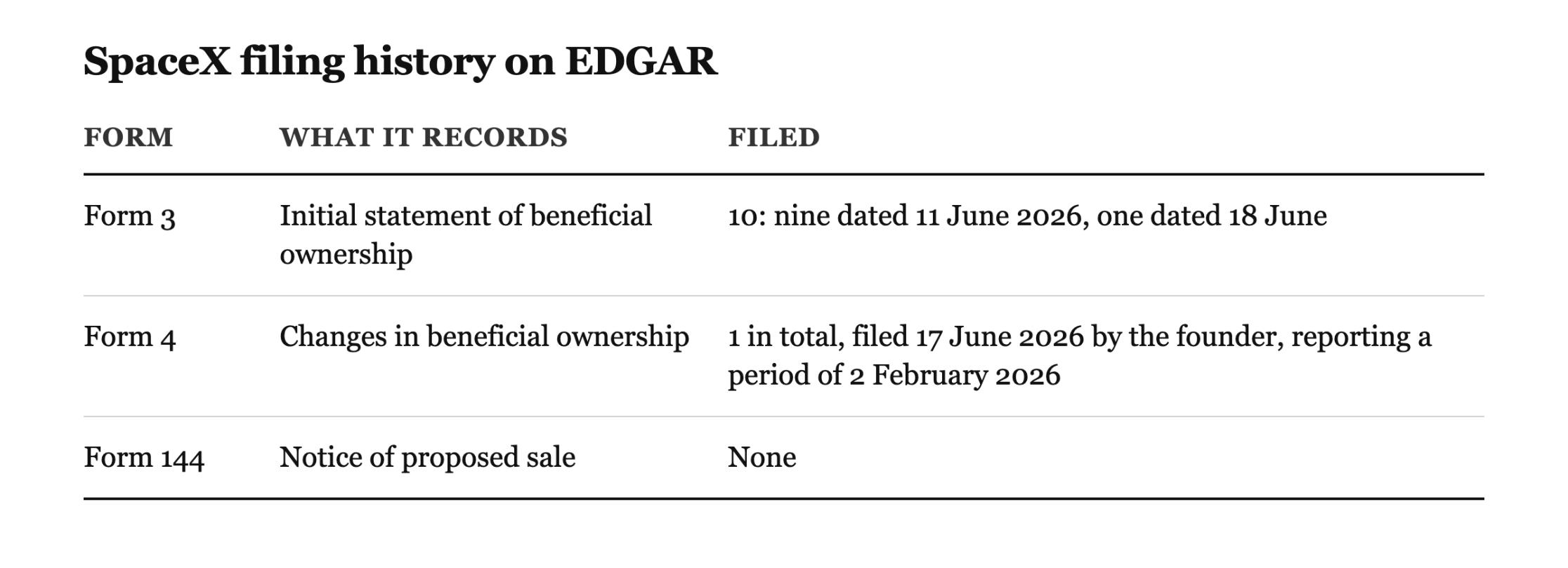
The most recent filing of any kind in this company's own filing history is dated 14 August 2026. (Individual insiders have filed since, for other issuers; that is the next section.)
So the reporting machinery exists. Ten people registered as insiders at or just after the listing, which is what a Form 3 is for. Between them, in the three months since, they have filed one Form 4 and not a single Form 144. And that one Form 4 is not what a casual reading suggests. It was filed by the founder in the week of the listing and reports a period of 2 February 2026. It describes a transaction from before the company was public. It is the paperwork of going public, not a record of anyone trading afterwards.
Read that way, the count of post-listing insider transaction reports is not one. It is zero.
That covers the 6 August release of up to 911.5 million shares. It covers the 20 August tranche. It covers the 9 September tranche. And it covers the affiliates' own release on 10 September, the one the 9 September piece said was the only part anyone could see.
Why This Is Not an Artifact of the Method
The obvious objection is that this is an artifact of where the search looked. That objection deserves closing off, and the honest place to start is that on Friday it was correct.
EDGAR's filing-type filter is a prefix match. Ask its browse interface for type "4" and it returns Form 4s and also the 424B4 prospectus. On Friday it returned two results, and the working count said two Form 4s. One of them was the final prospectus from 12 June. The company's structured submissions index, which types every filing exactly, returns one. Every count in the table above has been rebuilt from that index instead, and this paragraph stays in rather than quietly fixing the number, because the failure is more useful than the correction: a tool that answers a slightly different question than the one you asked will not tell you so.
Ownership forms are indexed under the reporting person as well as the issuer, so an issuer-level count could still miss something. We checked all ten Form 3 filers under their own identifiers and opened the underlying documents rather than trusting an index.
Three of them have filed a Form 4 since 1 June 2026. Setting aside the founder's single SpaceX filing described above, the one reporting a February transaction, not one of those filings is for this company; the issuer's own index contains exactly one Form 4, and that is it. The ones opened report transactions in Tesla, Polaris, Block, MongoDB and Ethos Technologies. One director accounts for eleven Form 4s on their own, including one filed on 10 September itself, the day of the affiliates' release, reporting a transaction in Ethos Technologies two days earlier.
The same director has filed Form 144s, too: two of them, on 1 and 2 June 2026, for Natera and MongoDB.
That is the strongest version of the check, and it is worth stating plainly. Inside this group of ten there is somebody who demonstrably uses both forms, in the months either side of this listing, who filed one of them on the very day the affiliates were released, and who has used neither of them for this company.
What This Does and Does Not Establish
Care is needed here, because an absence is the easiest thing in the world to over-read, and the temptation is to treat a blank record as a finding about intentions. It is not.
It does not mean nobody sold. Non-affiliates never file, and they are the overwhelming majority of everything released so far, up to 911.5 million shares on 6 August alone. Whatever they did is in the tape and nowhere else.
It does not mean affiliates sold nothing. Form 144 carries a de minimis exemption: sales at or under 5,000 shares and $50,000 in any three months require no notice. A quiet trickle at that scale is invisible by design.
It is not about the founder. Musk and the holders on the extended lock-up are not eligible to sell until 2027. Their silence is contractual, not chosen, and it would be dishonest to fold it into this.
And the window has now shut. A Form 4 is due within two business days. The affiliates' release was Thursday 10 September, so any trade that day had to be reported by Monday 14 September. That deadline has passed. We re-ran the check this morning: nothing has appeared, and the most recent filing of any type in the company's history is still 14 August.
What the record does establish is narrower and more interesting: at the moment the only observable cohort became free to act, the observable channel produced nothing to observe, and not because these are people who do not file. One of them filed that very day, for another company.
The Third Data Point
This is the third time the same question has been asked in this sequence, and the answers line up.
Eligible Was Not Sold, published on 10 August, argued that a lock-up expiry converts a legal restriction into a decision, and does not convert a share into a sale. Eligible is not sold.
The 9 September piece added the half of that argument it had not stated: for roughly 84% of what released that week, sold is not observable either, because the disclosure regime simply does not generate a record for non-affiliates.
Today adds the third: in the sliver where a record could have been generated, none was. The observable channel is not merely small and unrepresentative. It is frequently empty.
That matters for a habit this whole field has, these pages' included. Every retrospective account of a lock-up expiry, every "insiders sold into the unlock" and every "the overhang passed without incident," is built by inference from price and volume, because the direct evidence does not exist. The field reasons backwards from the tape because there is nothing else to reason from. What this week shows is that even where the direct evidence could exist, it often does not get created. The inferential apparatus is not a convenience. It is the only instrument in the room, and it is not a very good one.
What This Argument Does Not Claim
It suggests nothing improper. Filing a Form 4 requires a transaction to report. The straightforward reading of an empty record is that the people who would have to file did not trade, which is an entirely ordinary thing for insiders to do in the months after a listing, and is consistent with the August argument.
It makes no price argument, and nothing here is a view on where the stock goes.
And it does not claim this is unusual. We have not surveyed other listings, and we do not know what the base rate for insider filings in the first three months after an IPO looks like; quite plausibly it is close to this. That is a real limit, and this piece does not argue its way around it. What the ten filers establish is that the silence is not explained by a group of people who never file. It is not evidence that the silence is rare.
What Follows
The next dated releases are 24 September, then 9 and 24 October, each up to 328.4 million shares, and then the tranche tied to third-quarter results at up to 1.3 billion, by some distance the largest before December.
Each of those is another test, and the test is cheap: it is a public database, it is free, and it takes a minute. When the next piece of commentary tells you what insiders did with an unlock, the question to ask is not whether the analysis is clever but whether anybody checked whether a filing exists.
This time, one did not.
Sources: SpaceX filing history on EDGAR for CIK 0001181412, re-read on the morning of 15 September 2026 from the structured submissions index, which is complete at 81 entries with no continuation files, for the counts of Forms 3, 4 and 144 and their dates, and the date of the most recent filing of any type. The single Form 4 (accession 0001628280-26-044069) was opened: one reporting owner, Elon Musk, period of report 2 February 2026. All ten Form 3 documents were opened for the reporting owners' names and identifiers, and each owner's own filing index was then read for Form 4s since 1 June 2026 and for Form 144s of any date; six of those Form 4s and both of the June 2026 Form 144s were opened to establish the issuer. All ten filing histories were re-read on the morning of 15 September 2026. The Form 4 count of "two" carried in this piece before publication came from EDGAR's browse interface, whose type filter is a prefix match and returns the 424B4 prospectus (accession 0001628280-26-042639) alongside Form 4s; the corrected count comes from the structured index. Release dates and tranche sizes, comprising the 6 August release of up to 911.5 million shares, the 20 August, 9 September and 10 September tranches, and the subsequent releases of up to 328.4 million shares on 24 September, 9 October and 24 October and up to 1.3 billion after third-quarter results: SpaceX final prospectus (Form 424B4) filed 12 June 2026, table "Earliest Date Available for Sale in the Public Market", re-read in full from EDGAR on 14 September 2026. The two-business-day Form 4 deadline and the Form 144 de minimis threshold are the general rules as applied; the prospectus's own description of the Rule 144 conditions appears in the "Shares Eligible for Future Sale" section of the Form 424B4 cited above. Chan Ahn's pieces Eligible Was Not Sold (10 August 2026) and The Tranche You Can See (9 September 2026), as published under his byline, for the arguments revisited here. Figures are as of the dates given.
This is market commentary, not investment advice. It is not a recommendation to acquire, hold or redeem any Tessera product, or to take or avoid exposure to any company mentioned.
T-Tokens are tokenized loan participation rights, not equity. High risk. DYOR. Not financial advice. Not available in the US or other restricted territories. tessera.pe/terms