Nine Said No
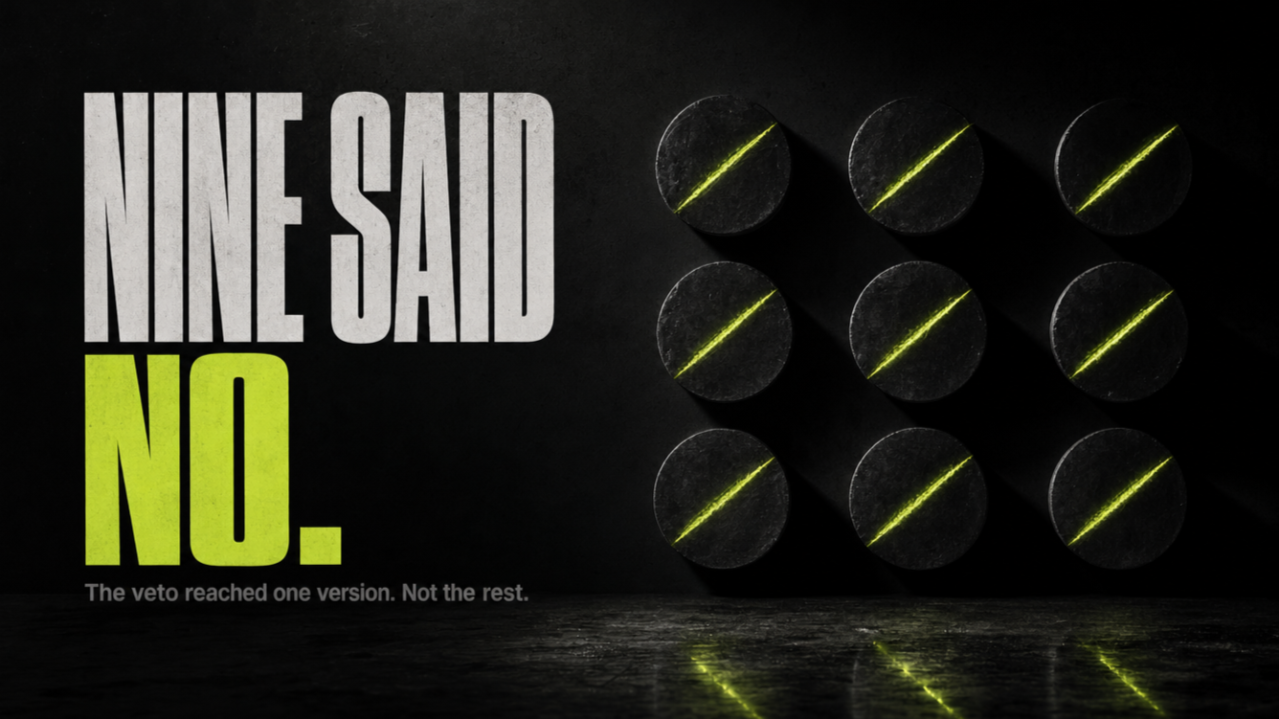
In a revised notice dated 8 October, a tokenized-stock venue that is not yet trading published a short list of companies that had told it no. OKXICE, a 50-50 joint venture between Intercontinental Exchange Holdings and OKC USA Holding, said it had received a Notice of Issuer Objection from Cerebras Systems, AppLovin, Applied Digital and Rocket Lab. A week later, in a notice dated 15 October, the list had nine names. These notices are the first public record we have found of companies using the veto in the SEC's order of 17 September, which lets a venue trade a company's stock in token form, including tokens made without the company's involvement, but only where the token carries the same rights as the ordinary share. For a token made by a third party the company must be told first, trading cannot begin for thirty days, and an objection inside that window stops it. All nine stocks are already offered offshore as tokens without shareholder rights. The veto reached the version that comes with those rights, on one venue. Over the offshore tokens, as we read the order, the companies have no say at all.
19 October 2026. Notices, listings and filings are as of the dates stated in the text.
Interest disclosure: T-OpenAI and T-Kalshi are tokenized loan participation rights providing economic exposure linked to those companies' pre-IPO valuations, each issued through a dedicated issuing subsidiary. T-SpaceX, issued through its own dedicated issuing subsidiary, provides economic exposure linked to SpaceX; following the SpaceX listing, the investment underlying T-SpaceX is being divested. Redemption opens only once a Redemption Start Date is announced, and as of 19 October 2026 none has been. SpaceX was on OKXICE's 4 October list, discussed below; Kraken offers a SpaceX xStock, and OKX's public instruments lists show a perpetual swap, a future and spot pairs referencing SpaceX (19 October), all offering exposure linked to the same company as T-SpaceX. T-Tokens provide economic exposure, not shareholder rights. They are not tokenized stocks, but on the comparison in this piece they sit on the same side as the tokens without the rights, and Tessera has a commercial interest in how that comparison comes out. Tessera appears as a quote-asset category on StonkFun, beside xStocks (stonkfun.xyz, 19 October), a launchpad Tessera has written about; Tessera has no commercial, integration or incentive arrangement with StonkFun or Raydium. OKX's public instruments lists also show perpetual swaps and futures referencing OpenAI and Anthropic (19 October), which compete for the same interest T-OpenAI serves. Tessera has no integration or arrangement with OKX, ICE, OKXICE, Uniswap, Kraken (including Payward Digital Solutions) or Backed, and no T-Token appears on OKX's or Kraken's exchange instrument lists (19 October). Tokens issued by Tessera appear in the token search of OKX's Web3 DEX (19 October); Tessera has no commercial, integration or incentive arrangement with OKX. No Tessera product references Anthropic, Cerebras, AppLovin, Applied Digital, Rocket Lab, CoreWeave, Verizon, Applied Optoelectronics, Broadcom, UnitedHealth, Alphabet, OKX, ICE or Kraken; none is planned. Tessera's founder, and entities he controls, hold related exposure. Read what follows with that in mind.
In a revised notice dated 8 October, a tokenized-stock venue that is not yet trading published a short list of companies that had told it no. OKXICE is run by OKXICE LLC, a 50-50 joint venture between Intercontinental Exchange Holdings and OKC USA Holding; its notice describes OKX Inc. as an affiliate of OKXICE LLC through OKC USA. The venue said it "has received a Notice of Issuer Objection from the following issuers": Cerebras Systems, AppLovin, Applied Digital and Rocket Lab. A week later, in a notice dated 15 October, the list had nine names. CoreWeave, Verizon, Applied Optoelectronics, Broadcom and UnitedHealth had joined it. OKXICE's page also lists a further notice dated 19 October, which could not be opened on that date.
OKXICE's notices of 4, 8 and 15 October are the first public record we have found of companies using the veto in the SEC's exemption of 17 September, which the SEC's press release called the Innovation Exemption. All nine stocks are already offered offshore as tokens without shareholder rights, as are others on OKXICE's 4 October list that had not been named as objecting. The veto reached the version that comes with those rights, on one venue. Over the offshore tokens, as we read the order, the companies have no say at all.
What OKXICE Is
As its notices of 8 and 15 October describe it, the venue will run on Uniswap v4 liquidity pools on XLayer, where "Only wallets holding a valid soulbound token ('SBT') issued by OKXICE TSV ... may trade in or provide liquidity to an AMM Liquidity Pool". OKX Inc. will run the venue's customer checks and, under a services agreement, its market surveillance; OKX Technology builds its software under another. Each token, the notices say, "represents a security entitlement to one share of the underlying NMS stock". It will be made by a tokenizer unaffiliated with the company, which holds the shares through a registered broker-dealer, with on-chain records "reconciled with the Tokenizer's books and records". Of the three forms Chan Ahn described to crypto.news on 11 September, that is the custodial one rather than the share itself: the holder has a security entitlement, and the rights reach the holder through the intermediary. OKXICE says it is "not subject to Regulation NMS" and is not registered with the SEC "in any capacity" for this activity. None of the notices gives a launch date.
The exemption is the SEC's order of 17 September (Release No. 34-106402), which calls itself the TSV Exemption. It lets a venue trade a company's stock in token form, including tokens made without the company's involvement, but only if the token "provides holders the same rights and privileges" as the ordinary share. OKXICE's own eligibility test spells out what that excludes: the token must represent the share rather than be "a tokenized linked security, security-based swap or other instrument providing only synthetic exposure to the underlying NMS stock". Its notice also requires holders to receive the same dividends and voting rights, and requires "proxy materials and other issuer communications" to be made available to them "at no cost to the issuer or to the holders".
For a token made by a third party, the company must be told first. Trading "may not commence until at least 30 calendar days" after it receives the notice, and if it objects "on or prior to the 30th calendar day following receipt", then "the TSV cannot make such Tokenized NMS Stock available for trading on the TSV". The venue must say so publicly "Within five business days". The notice requirement covers only tokens made by a third party unaffiliated with the company, so a token the company makes, or has made on its behalf, needs none. The order's text stops that venue. We have found nothing in it that stops the token being made, or another venue sending its own notice.
The SEC gave its own example of why a company might object: it "may be concerned about the risk of maintaining its shareholder register related to onchain transfers or the potential price dislocation or adverse effects on the price of the underlying NMS stock, particularly given that prices disseminated by an AMM Liquidity Pool are most likely based only on the ratio of the quantities of assets in that liquidity pool."
Three Notices in Eleven Days
OKXICE's first notice, dated 4 October, listed 63 symbols: 62 companies, with Alphabet's two share classes counted separately (our count from the notice). SpaceX was on it, and so were AppLovin, Applied Digital and Rocket Lab, and the five that objected later: CoreWeave, Verizon, Applied Optoelectronics, Broadcom and UnitedHealth. The 4 October notice allows for tokens made by or for the company, but the only model it describes in detail is an unaffiliated tokenizer's, and the 8 October notice says that is what it will trade. If the listed tokens are of that kind, listing them is the venue's representation that it has sent each company a notice (Release No. 34-106402, footnote 101). Cerebras was not on the list, but the same notice already named it as having objected, to trading OKXICE had not proposed in public. Having objected already may be why it was left off.
The revised notice of 8 October adds AppLovin, Applied Digital and Rocket Lab to the objectors. Separately, it drops the list. Where the first notice said OKXICE "will make the following Tokenized NMS Stocks available for trading", the second says only that it "will make available for trading Tokenized NMS Stocks that are tokenized by a third party unaffiliated with the issuer." The order asks a notice to identify the tokens the venue "makes available for trading", and nothing is trading yet, which may be why. The notice does not say.
On our comparison of the two texts, the notice of 15 October changes two things from the 8 October one: the date, and five more objectors, all of them on the 4 October list. It still names no stocks for trading.
An objection may not be a final no. As far as we can find, the order gives a company no way to take back its silence once its 30 days pass, and says nothing either way about withdrawing an objection. A company that objects also stays free to tokenize its own shares, which needs no notice. Objecting may therefore be the cautious answer rather than a final one, though the order does not say an objection can be undone. None of the nine has said why it objected in any filing we found: an EDGAR full-text search for "Notice of Issuer Objection" or "OKXICE" returned nothing between 17 September and 19 October. One has given reasons to the press. Crowdfund Insider reported on 18 October that a spokeswoman for Applied Optoelectronics told The Wall Street Journal the company was uncertain how tokenization would affect its share price, liquidity and volatility, was concerned that investors might think it had sponsored or endorsed an offering it did not initiate, and saw no clear benefit to the company or its shareholders. CoinCentral reported the same reasons that day. We have not read the Journal's article. This piece does not supply a motive for the other eight. The SEC's example is a reasonable one, and a company can have reasons nobody outside it can see.
The Same Stocks, Without the Rights
The same nine companies are already available in token form elsewhere (all pages and lists read 19 October):
- Kraken: offers all nine as xStocks: RKLBx, APPx, APLDx, CBRSx, CRWVx, VZx, AAOIx, AVGOx and UNHx. Each page says "holding tokenized equities does not convey any shareholder rights", and so do Kraken's pages for other names on the 4 October list that had not been named as objecting, SpaceX's among them. The pages also say the tokens are backed by shares held by a third-party custodian, so on that description one difference from OKXICE's token is the holder's claim rather than the collateral. Kraken's legal page says xStocks are "not accessible in the US, Canada, UK, or Australia", are issued by Backed Assets (JE) Limited, a Jersey company, and are offered to certain Kraken clients by Payward Digital Solutions, a Bermuda company.
- OKX, for the first four objectors: spot pairs named XCBRS, XRKLB, XAPP and XAPLD and perpetual swaps on all four stocks, every one listed between May and 8 September, before the SEC's order and before any objection.
- OKX, for the five later objectors: spot pairs named XCRWV, XAVGO, XAAOI and XUNH and perpetual swaps on CoreWeave, Broadcom, Applied Optoelectronics and UnitedHealth, listed between April and 8 September.
- OKX futures: contracts expiring in 2031 on Cerebras, Rocket Lab and AppLovin, the AppLovin one listed on 2 October, after the order, and on CoreWeave, Broadcom and Applied Optoelectronics, listed between 9 July and 27 August.
- Verizon: nothing on any of OKX's three lists.
The OKX brand is run by several companies: its terms name OKX Inc., a Delaware company, for US users, and others, including a Seychelles company, for users elsewhere. We have not established which of them offers these instruments, what the X tokens carry, or whether US users can trade them. This piece makes no claim about how much of any of this trades; a listing says nothing about volume.
So the veto falls where the exemption applies, and the exemption admits only the version required to carry the rights. On a venue under this order, a third party's token that is a security entitlement to a share needs the company not to object, and a token without the rights cannot come onto the venue at all. Offshore, tokens that Kraken's pages say convey no shareholder rights are already offered on these companies and on others; OKX's lists also carry derivatives on them, from an OKX entity we have not identified; and we have found nothing in the order that gives the companies a say over either. Of the things that differ between the two, two decide whether the veto applies, the rights and the jurisdiction, and we cannot separate them.
As we read the notice, OKXICE's tokens would not put holders on the company's register. They would sit on the tokenizer's books, and the tokenizer runs the pass-through. The company's exposure is its dividends, votes and communications reaching holders through a tokenizer, on a venue whose prices come from a pool. Of the SEC's two examples, then, the price one fits this token's design more directly than the register one. That by itself says nothing about why the other eight objected, though the reasons reported for Applied Optoelectronics are closer to the price example. On 11 September, about closely held companies that keep their own registers, Chan Ahn told crypto.news: "A token cannot move what the register will not record." A listed company has no lever of that kind. The lever this order gives it is the objection, and it reaches only the token that promises holders a shareholder's rights.
The custodial token this order admits also corrects something Chan Ahn wrote in July. In an article for Fintech Bloom on 8 July, describing the SEC staff's statement of January, he wrote that "unaffiliated third parties without issuer involvement offer synthetic exposure." That was too broad even then, and the same article said so two paragraphs later, where it said the regulator had described third-party tokenized securities that "can be custodial, with intermediaries holding shares, or synthetic instruments like linked securities and swaps". The staff statement itself describes the custodial model, "such as a tokenized security entitlement". On 29 July, in Going Public by Degrees as published under his byline, Chan Ahn called the line between issuer-sponsored tokens and third-party wrappers "the whole game"; on 11 September, as on 8 July, he split the third-party side in two. What the September order changes is that one kind of third-party wrapper, the custodial one, now has a route onto a US venue that the synthetic kind lacks, provided it carries the rights and the company does not object.
What Cuts Against This
It is still a minority of the 4 October list, and an early count. The count more than doubled in the week to 15 October, and Cerebras shows that objections are not confined to that list, so how many companies OKXICE has notified in all is not public. Eight of the 62 companies on the 4 October list have objected, plus Cerebras, which was not on it. As of the 15 October notice, 54 of the 62 had not been named as objecting. But no company's 30 days could have run out by 15 October: the order is dated 17 September, and the clock starts when the company receives its notice, which the documents do not date. The venue then has five business days to publish an objection. If the listed tokens are of the third-party kind, the 4 October list is OKXICE's representation that those companies had been sent notices, so every window on it should close by early November, allowing for delivery, and some may already have closed. The count is an early one, and may have moved.
The venue is also not live. On 28 September, Tessera's piece Something That Moves set two tests for its argument that retail adoption of tokenized assets is arriving through convenience rather than through rights-first design. The first was: "If rights-first venues draw holders at scale once they are live under the SEC's exemption, the preference described here is weaker than it looks." OKXICE is not the first venue to publish a notice under the exemption. TSV LLC, a Puerto Rico company, published one dated 23 September, listing no stocks and reporting no objections (tokenizedstockvenue.com). Perpetuals.com, a Nasdaq-listed company, announced on 14 October that it was publishing a notice of its intent to rely on the exemption; as of 19 October we have not found the notice itself. OKXICE is the first we have found to have named, in its 4 October notice, the stocks it intended to trade.
It is not quite the rights-first venue the 28 September piece described, which put the registered share itself on-chain: OKXICE's tokens are entitlements held through a tokenizer that must pass the rights through. Under the exemption's terms, this piece counts it. That test has not started, and when it does it will not be a clean one:
- The veto removes names from what the venue can offer.
- The order caps trading in each token at 0.25% or 2.5% of the stock's average daily volume in the prior month, depending on its tier. The caps limit trading rather than holders, so they bear on the test less directly than the veto does, but a venue that cannot trade much may not attract many holders either, so a small following would be weaker evidence for the view than it looks.
- The two versions are not offered to the same people: Kraken's legal page says xStocks are not accessible in the US, Canada, the UK or Australia, so a large US following for OKXICE would not show a choice between them.
But the test as set was whether rights-first venues draw holders at scale, and if OKXICE does, Tessera will count it against the view. Tessera will score the second test on Wednesday 21 October.
Tessera's own position should also be stated plainly. On both things that differ here, rights and jurisdiction, T-Tokens are on the same side as the xStocks: they carry no shareholder rights, and under Tessera's terms they are not available to persons in the US or other restricted territories, on any venue. They differ in being tokenized loan participation rights providing economic exposure, rather than tokenized stocks. As we read the order, which covers tokenized NMS stock, neither this exemption nor its veto reaches them. The 28 September piece called the SEC's "same rights and privileges" test a good one, said its better use would be as a disclosure standard any venue can display, and added that "a disclosure standard is easier for products like Tessera's to meet than a gate would be." An issuer veto that reaches only rights-bearing tokens is, as we read this order, a condition products like Tessera's are not subject to, because under Tessera's terms they are not for US persons and could not use this exemption at all. Whether that counts as an advantage depends on where holders want to be, and Tessera is not the neutral party to judge it. Weigh this reading accordingly.
What to Watch
- The list: whether OKXICE's list of stocks comes back, and in what form.
- More objections: whether more companies object before OKXICE starts trading.
- Reasons: whether the other eight explain themselves, in a filing or anywhere else.
- Holders: once the venue is live, whether it draws holders at scale.
Sources: OKXICE TSV, public notices dated 4, 8 and 15 October 2026, re-read 19 October 2026, okx.com/en-us/okxicetsv; the same page's listing of a notice dated 19 October 2026, not openable on 19 October. US Securities and Exchange Commission, Release No. 34-106402, order of 17 September 2026 (91 Fed. Reg. 60168, 22 September 2026), and press release 2026-90, 17 September 2026, re-read 19 October 2026; SEC Division of Corporation Finance and others, Statement on Tokenized Securities, 28 January 2026, re-read 19 October 2026. TSV LLC, public notice, version 1.0, 23 September 2026, tokenizedstockvenue.com, read 19 October 2026. Perpetuals.com Ltd, press release, 14 October 2026, perpetuals.com, read 19 October 2026. Kraken, xStocks pages for the nine and for others on the 4 October list, and the xStocks legal page, kraken.com, read 19 October 2026. OKX public instruments lists (spot, perpetual swaps and futures), okx.com, terms of service and Web3 DEX token search, read 19 October 2026. Kraken public assets list, read 19 October 2026. StonkFun homepage, stonkfun.xyz, read 19 October 2026. SEC EDGAR full-text search, 17 September to 19 October 2026. Crowdfund Insider (Omar Faridi) and CoinCentral, 18 October 2026, read 19 October 2026, Crowdfund Insider reporting Applied Optoelectronics' statement to The Wall Street Journal. Chan Ahn's answers to crypto.news, 11 September 2026; his Fintech Bloom article of 8 July 2026; and "Going Public by Degrees", 29 July 2026, as published under his byline. Tessera, "Something That Moves" (28 September 2026), as published at blog.tessera.pe.
This is market commentary, not investment advice. It is not a recommendation to acquire, hold or redeem any Tessera product, to use any platform mentioned, or to take or avoid exposure to any asset mentioned.
T-Tokens are tokenized loan participation rights, not equity. High risk. DYOR. Not financial advice. Not available in the US or other restricted territories. tessera.pe/terms